From Paper Trade to Agentic Trade
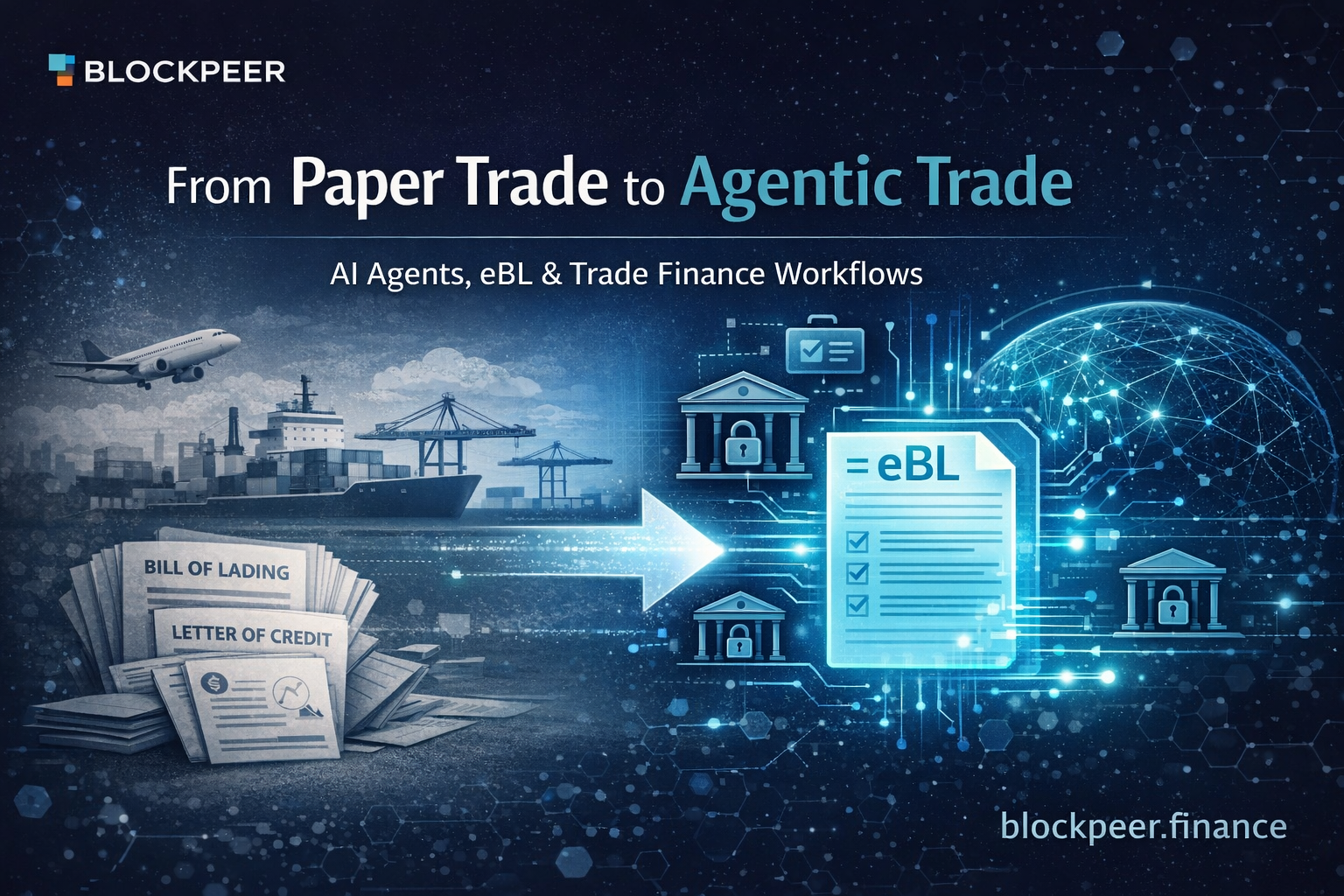
How AI Agents May Transform Bills of Lading and Letter of Credit Workflows
Global trade is built on documentation and trust. For centuries, the movement of goods across borders has been supported by documents that represent ownership, shipment details, and payment obligations between trading partners.
Among these, the Bill of Lading has played a central role. Issued by a carrier, it represents receipt of goods and serves as a document of title that can be transferred between parties. In parallel, Letters of Credit rely on the presentation and examination of trade documents to ensure exporters are paid once contractual conditions are fulfilled.
While these processes underpin trillions of dollars in international commerce, they are also operationally complex. Exporters, shipping lines, freight forwarders, and banks must coordinate document preparation, transfer, and verification across multiple systems and jurisdictions.
Over the past decade, the industry has made meaningful progress toward digitization. Electronic Bills of Lading and digital trade documentation frameworks have begun replacing paper-based workflows.
But digitization alone does not remove the complexity of global trade.
Even when documents are electronic, the orchestration of trade workflows often remains manual, requiring coordination across multiple institutions.
At the same time, a new capability is emerging. AI systems are evolving from passive assistants into software agents capable of executing tasks, coordinating services, and interacting with external infrastructure.
This raises an important question.
What happens when trade infrastructure is not only digital, but also accessible to intelligent software agents?
At Blockpeer, we believe this marks the next phase of trade evolution.
As a step toward this future, we are introducing the Blockpeer eTrade MCP Server, enabling AI agents to interact directly with digital trade infrastructure.
From Digital Trade to Agentic Trade
The first phase of trade digitization focused on replacing paper documents with electronic equivalents. Electronic Bills of Lading, digital registries, and interoperable frameworks made it possible to issue and transfer documents without physical movement.
These advances significantly improved efficiency.
However, the workflows around these documents have remained largely human driven.
Exporters still gather documents manually.
Logistics teams coordinate shipment records.
Banks review document presentations under Letters of Credit.
The next phase goes beyond digitization.
It introduces agentic trade, where intelligent systems assist in coordinating trade workflows. These systems can issue & retrieve documents, verify authenticity, prepare document sets, and coordinate processes across multiple participants.
For this to be possible, trade infrastructure must be accessible in a way that AI agents can understand and interact with.
The Role of the Model Context Protocol
The Model Context Protocol provides a structured way for AI agents to discover and interact with external systems.
Instead of relying only on traditional API integrations, an AI agent can connect to an MCP server and automatically discover available tools and operations.
These tools represent structured capabilities that the agent can invoke programmatically.
APIs remain essential for developers. MCP extends this capability by making infrastructure accessible to intelligent systems that operate dynamically across services.
This creates a new access layer for digital infrastructure.
From Paper Bills of Lading to AI Accessible Trade Documents
For centuries, the Bill of Lading has existed in paper form.
It has carried legal weight, enabled transfer of ownership, and formed the backbone of global trade transactions. At the same time, it has required physical handling, courier movement, and manual verification.
The transition to electronic Bills of Lading was a significant step forward. Digital documents enabled ownership transfers without relying on paper while maintaining legal validity under modern legal frameworks.
However, interaction with these documents has remained largely human driven.
What changes with MCP enabled infrastructure is not just digitization, but accessibility.
Through the Blockpeer eTrade MCP Server, AI agents can interact directly with legally valid electronic Bills of Lading.
This is a fundamental shift.
AI systems are no longer limited to processing trade data. They can now access, interpret, and act upon legally enforceable trade instruments.
Because these documents are machine readable, AI agents can:
- issue, retrieve, and interpret Bill of Lading data
- verify document authenticity and ownership
- coordinate transfer, endorsement, and surrender operations
- integrate document flows into trade and financing workflows
This creates the foundation for a new kind of trade infrastructure.
Agent Driven Trade Flow Management
To understand the impact of this shift, consider a typical export transaction under a Letter of Credit.
Traditionally, exporters prepare shipping instructions, carriers issue a Bill of Lading, and exporters assemble documents for presentation to the bank.
Banks then review these documents against the Letter of Credit terms to identify discrepancies.
In an agent enabled environment, many of these steps can be coordinated by intelligent systems.
An exporter’s AI agent can retrieve shipping instructions directly from trade contracts or purchase orders. It can then interact with the Blockpeer MCP server to issue an electronic Bill of Lading.
Because the document is machine readable, the agent can verify shipment details, ensure alignment with contract terms, and prepare the next steps in the workflow.
Subsequent operations such as transfer, endorsement, or surrender of the Bill of Lading can be handled programmatically through coordinated agent interactions.
The same applies to trade finance workflows.
A shipper’s AI agent can assemble required documents and generate a Letter of Credit presentation.
On the banking side, AI agents can retrieve documents, verify authenticity, perform discrepancy checks, and coordinate with other agents to resolve issues before forwarding the presentation to the issuing bank or advising clients.
In this model, institutions retain full control over decisions, while intelligent systems assist with execution and coordination.
MCP for Fintech Platforms
Fintech platforms involved in trade finance require reliable access to trade documentation and transaction data.
By connecting to Blockpeer’s MCP infrastructure, fintech systems can enable AI driven workflows that retrieve and verify trade documents automatically.
Agents can assist in preparing financing requests, validating trade assets, and coordinating interactions between exporters and financial institutions.
MCP for Exporters and Shippers
Exporters and shipping companies manage a complex set of documents for every transaction.
AI agents can assist by retrieving digital trade documents, organizing shipment related information, and coordinating document transfers between parties.
They can also ensure that required documents are available for customs, financing, or payment processes.
MCP for Banks and Financial Institutions
Banks play a critical role in document verification and trade finance.
Through MCP enabled infrastructure, AI systems can assist banks in retrieving trade documents, verifying authenticity, and reviewing Letter of Credit presentations.
This reduces manual effort while maintaining the integrity of established trade finance processes.
Why Agentic Trade Matters
Global trade involves coordination across multiple independent participants.
Even in a digital environment, much of this coordination remains manual.
Agentic trade introduces a new model where intelligent systems assist with document handling, verification, and workflow management.
This does not replace institutions. Instead, it enhances their ability to operate efficiently within complex trade ecosystems.
As trade infrastructure becomes machine readable and interoperable, AI agents can play a meaningful role in supporting trade operations.
The Next Phase of Trade Infrastructure
Trade infrastructure has evolved through several stages.
The first stage relied on paper documentation.
The second stage introduced electronic documents.
The third stage brought programmable systems through APIs.
The next phase may involve agent coordinated trade workflows, where intelligent systems interact directly with trade infrastructure.
The Blockpeer eTrade MCP Server represents an early step toward this future.
By enabling AI agents to access legally valid trade documents and interact with trade workflows, we are moving toward a model where global trade operations can be more efficiently coordinated.
Getting Access to the Blockpeer eTrade MCP Server
The Blockpeer eTrade MCP Server is currently available to partners and organizations exploring AI driven trade workflows.
We are working closely with fintech platforms, exporters, shipping companies, and financial institutions to integrate agent based systems into real trade environments.
If you are building AI powered applications in trade, logistics, or trade finance, we would be glad to explore how Blockpeer MCP can support your use case.
To request access or learn more, please reach out to our team at hello@blockpeer.finance
Explore how BlockPeer can help you access faster, more secure capital through tokenized trade assets like ePNs.
Explore how BlockPeer can help you access faster, more secure capital through tokenized trade assets like ePNs.
